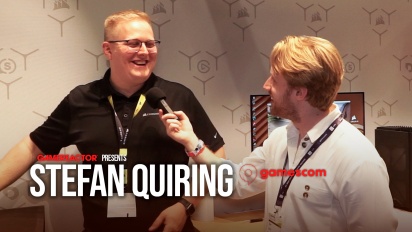
Natutunan namin ang lahat tungkol sa bagong tagabaril ng militar ng Counter-Strike co-creator, ang katayuan nito at kamakailang pag-unlad. Bukod dito, sumasalamin si Le sa mga nakaraang proyekto tulad ng Tactical Intervention, paparating na Plan-8 ng Pearl Abyss, o ang maalamat na Counter-Strike mismo at ang mas bagong CS2.
"Hi Gamereactor friends, it's the first day of Devcom and I'm here joined by one of the main speakers today, which is Minh. Thank you so much for joining us.
It's the third time I interview you, I think, but we met very long ago in Barcelona at Gamelab. I think it was 2013, 2016.
Wonderful, beautiful. I really enjoyed that Gamelab and just being there. I hope to go there again. Do they still do Gamelab?
Sometimes. Satellite format is still going sometimes and it's a format we also enjoy as well."
"But you're here talking about both your career and your game Alpha Response, which you have a booth for at the Gamescom starting on Wednesday.
So first and foremost, let me ask you about the game. What is the status of the game? What are you guys sharing here at the show?
And what is the feedback you are getting and expect to get from players gathered here in Cologne?
So the game is called Alpha Response and right now it's in early access. It's on Steam. So if people want to check it out, they can get it on Steam early access."
"And so we've been on early access for about eight months now and we've been getting some pretty good feedback from players.
They seem to enjoy the open world of our game and they really enjoy the dynamic firefights.
Everyone seems to say that the game feels a lot like Payday and so I think we're really happy with the feedback.
We're just taking a lot of the suggestions from the players and just trying to make the game better from feedback."
"So I think it's been going good and I'm really happy with the reception that it's been getting so far.
So we're working really hard to just reach the 1.0.
What's the current status? Do you expect to reach the 1.0 around this quarter?
No, I think we're shooting to reach 1.0 probably sometime in the middle of 2026 maybe or early 2026."
"So I think probably another eight months, eight to nine months.
So I think that's a pretty reasonable estimate.
I think the progress is coming along though. We're making really good progress.
The game's really improved since we first started in November and we've made a lot of great improvements."
"And the players are starting to notice it too because when we first released it we were getting a lot of negative feedback.
Complaints about this, about the AI.
But we've fixed a lot of that and nowadays players are really happy with the AI.
And so the performance was also another thing that they were complaining about."
"But now I think we've optimized the game and it runs quite well now.
So I think we're slowly starting to make the game much better.
And I think right now it's in a really good state though.
I'm really happy with the game in its current state and we continue to improve it."
"And now that you mentioned the technical side of things and performance, why did you guys choose to go for UE4?
Well actually the project started about four years ago so at the time there was no Unreal 5.
And so basically we just chose Unreal 4.
And when Unreal 5 came out we had to make the decision of whether or not we should port our game to Unreal 5."
"And it's not easy because we have a fairly small team.
And to do a proper conversion to Unreal 5 it would have set us back maybe four or five months.
And we felt like we'd rather try to make the game better.
No need."
"And we felt like Unreal 5 graphically it's capable of doing a lot of really good graphics.
And so I think we're just doing our best with Unreal 5.
And I'm pretty happy with what we've been able to achieve with it though to be honest.
I mean there's not many things in Unreal 5 that I really want that Unreal 4 doesn't have."
"And another thing is our game we're trying to target a modest PC.
Our PC requirements are fairly modest.
We want it to run on low-end PCs as well.
So being on Unreal 5 kind of helps in that regard."
"Because it's a little bit less demanding for the PC than Unreal 5.
Okay, now that you mentioned feedback.
And one bit I missed from your panel was about Tactical Intervention.
I think that when we first met we were talking about TI all the time."
"So which would you say was the main lesson learned from that project?
Oh, I think the main lesson that we learned first, because it was a multiplayer FPS game.
The biggest mistake that we made was we were developing the game in a closed environment.
And that's really difficult to do for multiplayer games."
"Because I feel like with multiplayer games you really have to get the game out.
And you really need to get feedback from players at a really early stage of development.
Because that way you can understand which parts of the game aren't working.
And it allows you to kind of pivot your game direction based on early feedback."
"And because we didn't do that with tactical intervention.
When we released the game, people were complaining about a lot of features that we could have fixed early on.
So that was the biggest problem.
We didn't get that feedback early on."
"And it just made it very difficult for us to fix the game when we shipped it.
So I think that was just a big mistake.
Just not using early access.
Which clearly is something that you are not doing now."
"You have more play testing going on.
We released it in early access and we're taking our time to get the feedback.
And it's been really helpful.
Because a lot of the feedback that the players are giving us is stuff that we didn't see ourselves."
"So when they're telling us, you should do this, you should do that.
It's really helpful for us because we didn't actually see that.
So it helps us to kind of guide which parts of the game that they feel needs to be worked on the most.
And another stage that I found interesting about your career and about your panel was with Pearl Abyss."
"Of course it was a much bigger project.
Many more people.
The way the studio was structured as a AAA was different.
You now act more as indie slash AA sort of thing."
"I would say we're much more indie now.
So what can you tell me about that and how you sort of enjoyed the technical progress of the company?
Working at Pearl Abyss was really different than what I experienced at any of my previous companies.
Because they were such a large company."
"It almost feels like working at a company like Activision or EA.
Because you have so much incredible talent surrounded and you have really good resources.
And so you're able to kind of create some of the best looking content visually and appealing.
And so that was something that I never had access to before."
"Many of the projects that I worked on before, they were much smaller scale.
So being able to work on Plan 8 at Pearl Abyss, it just allowed us...
It just gave me a lot of freedom to try to do a lot of different things that I never would have been able to do at my previous projects.
So that was really awesome."
"And they were a really wonderful company to work with.
They treated me so well.
And I kind of regret not being able to stay there a bit longer and finish it.
But yeah, I'm really proud to have worked there."
"And I'm really excited to see the project that I work on, Plan 8.
I'm really excited to see them finish it.
Because when I was working on that project, I was really excited to see the stuff that we were creating.
And it was really cool looking stuff."
"And they have such great artists and programmers.
So hopefully one day I'll be able to see that project and play it with my own hands.
Yeah, it looked very ambitious.
We are also really looking forward to try and see more about that one."
"And also, of course, I have to ask you about Counter-Strike.
Because, you know, as you gathered so many people, you were signing autographs.
Many people still remember your first big project, right?
So how do you feel about it?
Looking back at what was the original game and also about the most recent versions."
"I'm really happy with what Valve has been able to do with Counter-Strike.
As I said in my speech, when I started the project, no one imagined that it would last this long.
When you make a game like that, you kind of think that it would just die out after a few years.
But Valve have been so good at maintaining the core aspect of Counter-Strike."
"They've been careful not to change the formula.
Because they know that's why people keep playing the game.
They know that this is the perfect gameplay and they're careful not to change the gameplay.
And so they've spent a lot of time just making the game, the visual aspect of it."
"Kind of updating it so it looks as good as it should in 2025.
The latest version of Counter-Strike, I've been playing and I've watched people play it.
And I'm really impressed with what they've been able to do.
It still feels like Counter-Strike, the version that I made in 1.6."
"But it just looks way better and it just seems to play much better as well.
I think I'm really happy with the direction it is.
I'm just really proud to be able to see people still play Counter-Strike.
It amazes me."
"I think Valve have a lot to do with the continued success of it.
What would you tell fans that still want to play the old version?
I would say you've got to give CS2 a chance.
I think it's really an incredible game."
"I do understand why people still play 1.6.
People tell me that it just runs better on their machines and that kind of thing.
But eventually, as people's computers become better, hopefully they'll move to Counter-Strike 2."
"Because I think Counter-Strike 2 feels a lot like 1.6.
But I think just visually it has so much better graphics.
And being so much into the design and the feel of first-person shooters, other than your game that is coming out as well, did you see anything that stood out to you recently?
Oh, you mean like..."
"Other games, other ideas, the bigger, the wider FPS genre.
Oh, so I think...
In this day and age, there are so many games that are coming out.
Every day I'm seeing a lot of really cool games."
"A lot of them are made by indie developers.
And I'm seeing so many cool games that are being developed.
And they're really small titles, nobody really hears about them.
But I know on Twitter I saw a couple of games that I saw."
"The names of them, unfortunately I don't recall them.
You can tell me later and we will print them here.
Yeah, I mean one of them, it's based on Hong Kong action movies from the 90s.
And it's called... Oh God, I forgot what it's called."
"But I'll tell you later.
But it's a really cool game because it feels like one of those movies that you...
If you watch Hong Kong movies from the 90s, the action is really over the top, very stylish.
And what this guy is trying to create is it looks really very similar to those movies."
"And I think it's really cool.
And I really hope that they can do better.
I'll tell you the name of it later and you can check it out and put a link to it.
Because I think it deserves more attention."
"So it's games like that I really feel are really exciting for me to watch as a game developer myself.
It's really encouraging to see that.
And it makes me kind of more motivated to work better on my game as well to be able to give back to the game community."
"Actually what you just did today was to give back to the gaming community with your speech.
I think that was fantastic.
It's very valuable.
So I have to thank you for that."
"And also enjoy the rest of the show and hope to see you soon.
And thank you for the interview.
It's a pleasure being on Gamereactor."